
LOOK AT THESE TWO RUNNERS. WHOSE FORM DO YOU THINK IS BETTER?
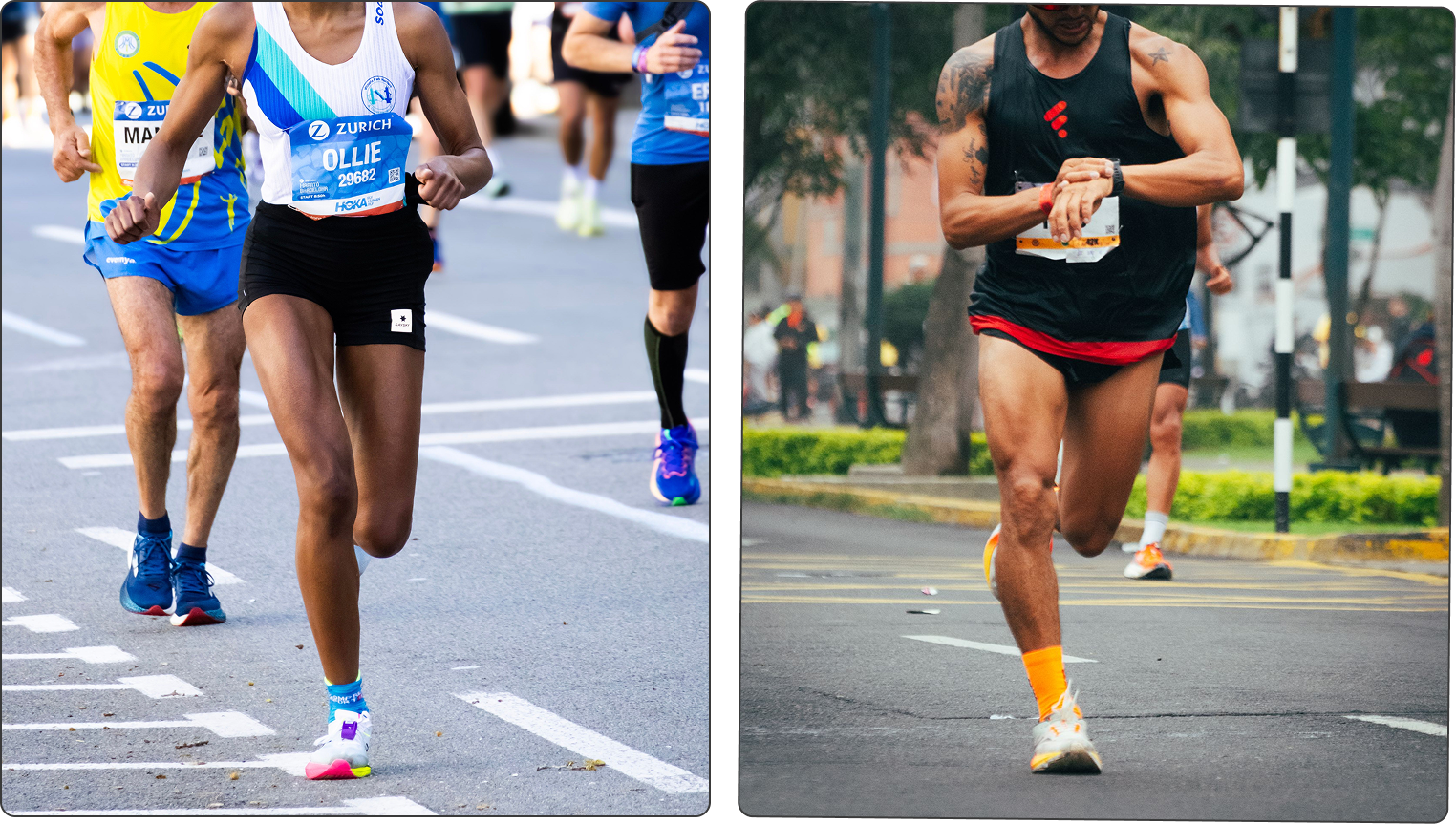
If you guessed the runner on the right, you’re correct. Most people, even those without any formal training, can spot poor running form when they see it. There's something instinctive about it.
A GOATA recode is designed to take someone who moves like the person on the left and get them moving like the person on the right. And it's not just a running fix. Its purpose is to get you moving the way evolution designed you to move. Because of that, it carries over to virtually every athletic activity.
THE WHAT
A GOATA recode is a full movement overhaul. Think of it like reinstalling a computer's operating system: instead of patching one glitch after another, we hit reset and reinstall the software your nervous system has had since birth. The outcome is that your body's natural posture and gait mechanics are restored.
GOATA was built by studying four groups: infants learning to crawl and walk, hunter-gatherer tribes who still move as our ancestors did, elite athletes with long, virtually injury-free careers, and octogenarians who still run marathons.
THE WHY
Your body takes the path of least resistance. After years of sitting in chairs, wearing tight shoes, suffering injuries, and developing poor posture habits, your body finds workarounds. A weak ankle gets compensated for by the knee and hip. A stiff hip gets compensated for by the lower back. These workarounds feel normal because you've been doing them for so long.
And they add up. These dysfunctions are a major contributor to most non-contact injuries and a large share of chronic pain.
The payoff: move your body the way it was designed to move, and everything else gets easier
THE HOW
GOATA starts at the bottom and works its way up, literally. The training is very foot and ankle focused, and it mirrors how babies learn to move. We start with exercises on the ground that mirror crawling patterns, then translate those patterns to walking and running.
Every recode is tailored to the person, but the process generally looks like this:
Assess. We look at how you currently stand, walk, and run, so we have a clear, honest baseline. Photos and reference images make this concrete rather than abstract.
Restore access. Before a body can move well, it needs the range of motion to get into good positions. We use targeted mobility and activation work, starting with the feet and ankles, to unlock what's stuck and wake up what's asleep.
Rebuild from the ground up. This is the core of the recode. We begin on the ground with crawling patterns, then practice the phases of your running gait, first in isometric holds and then in slow, deliberate movement, so your brain and body learn the new pattern.
Integrate. Once the patterns are clean, we blend the pieces together through crawling, walking and running drills designed to rewire your nervous system.
Reassess. We come back to where you started, see the change, and choose the next priority.
WHAT TO EXPECT
A recode isn't a one-and-done fix, and it isn't a grueling strength workout. Sessions often feel quieter and more precise. Think a flowy yoga session with lots of isometric holds and a bit of crawling, walking, or running at the end. Many clients notice changes in how they feel within a few sessions, while lasting change comes from consistency over weeks and months.
IS IT FOR YOU?
A recode is a great fit if you:
Want to stand, walk, and run better
Are recovering from a foot, ankle, knee, or hip injury
Want to unlock your body's full athletic potential
Are preparing for a marathon, backpacking trip, military, fire, or police service
Want to age well and stay active
If any of that sounds like what you've been looking for, the first step is simple: reach out to book an assessment.
